← Back to Blog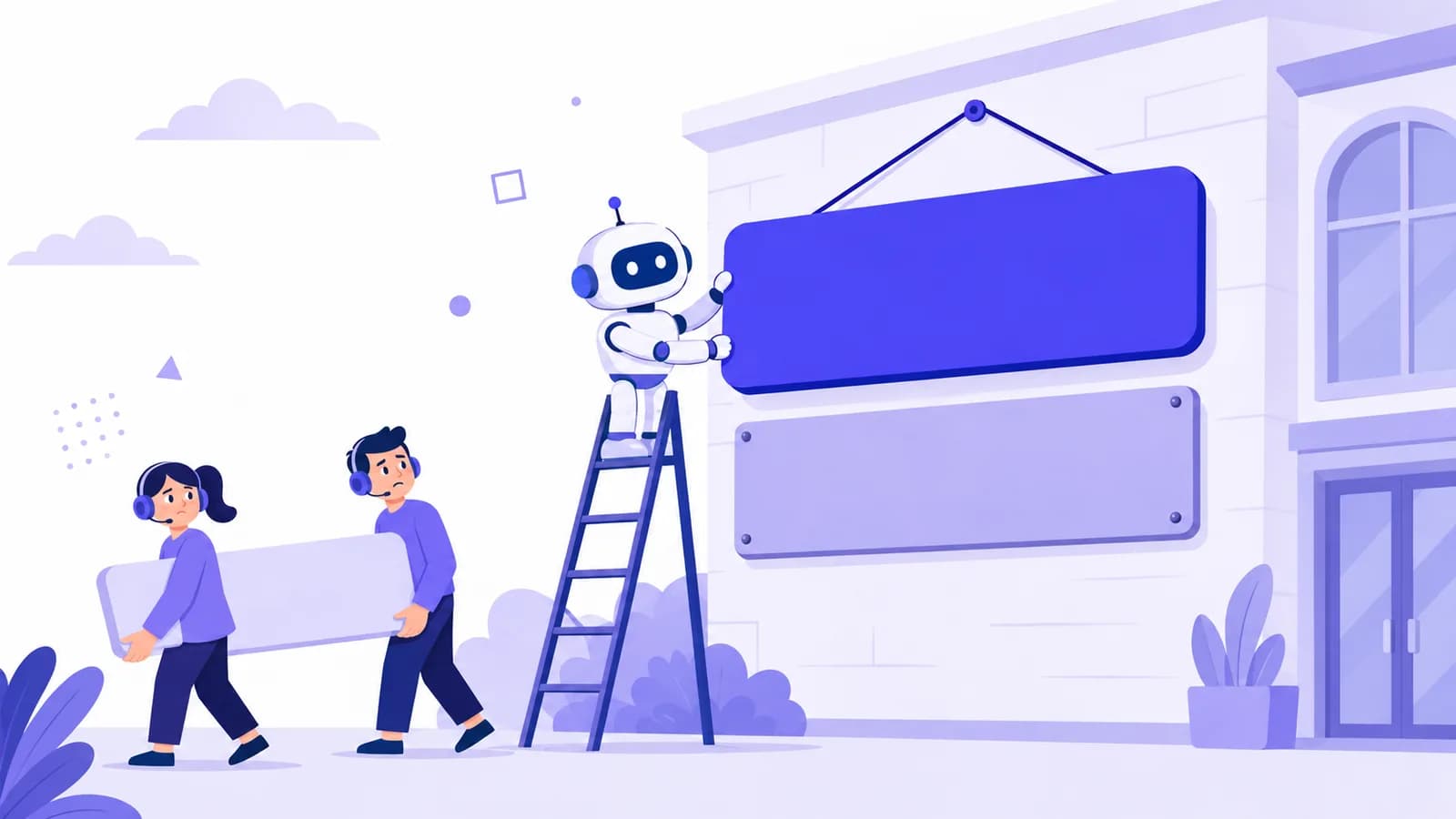
Intercom Just Renamed Itself After an AI Bot — Here's What That Means for Customer Service
·6 min read
Update - 23 September 2026: The deal has closed. Salesforce completed its acquisition of Fin (formerly Intercom) on 10 September 2026 (Salesforce press release, “Salesforce Completes Acquisition of Fin”). Our June note on this article forecast a close in early 2027; it closed sooner. The announcement says nothing about changes to Fin’s pricing or packaging, so treat any figure below as the last published price and check your own renewal terms. That changes the calculus in this article - see our full analysis: what the Salesforce acquisition means for your support team.
Intercom, one of the biggest names in customer support software, just renamed its parent company to "Fin" — the same name as its AI agent. The product stays "Intercom," but the 1,400-person corporate entity is now officially Fin.
CEO Eoghan McCabe framed the move as shedding "baggage" — acknowledging that the Intercom brand, built over 14 years of messenger-first customer communication, was weighing the company down as it pivots to AI. It's a striking admission from a company that once defined modern customer messaging.
If you're a support team leader evaluating helpdesk tools in 2026, this Intercom Fin rebrand tells you more about the state of the industry than any product announcement could.
What Actually Happened
On May 13, 2026, Intercom announced that the parent company would rebrand as "Fin," named after the AI agent they launched in 2023. Key details:
- The product keeps the Intercom name — customers still use "Intercom" day to day
- The corporate entity is now Fin — all 1,400 employees work for Fin
- Fin AI agent is approaching $100M ARR — a genuine commercial success
- 66% average resolution rate — meaning Fin resolves two-thirds of conversations without human intervention
- Pricing: $0.99 per resolution — unchanged from the current model
McCabe explicitly said newcomers have an advantage because they carry "no baggage." When the CEO of a $1B+ company says their own brand is baggage, it's worth paying attention to what that means for the market.
Why This Matters: The "Baggage" Problem
Intercom's rebrand isn't just marketing. It reflects a fundamental challenge that legacy support platforms face: their architecture, pricing models, and product assumptions were built for a pre-AI world.
The architecture baggage
Intercom was built as a messaging platform first. Chat windows, in-app messages, product tours — the entire system was designed around human-to-human conversation. Bolting AI onto that architecture means the AI agent inherits design decisions made for human agents: conversation threading, availability schedules, routing rules that assume a human is at the other end.
The pricing baggage
Fin's $0.99-per-resolution pricing model is the clearest example of legacy thinking. When AI resolves 66% of conversations, that sounds great — until you do the math. A team handling 10,000 conversations per month pays $6,600 just for AI resolutions, on top of per-seat costs starting at $39/seat/month.
Worse: as the AI improves and resolves more conversations, your bill goes up. You're penalized for the AI getting better. A 66% resolution rate at 10,000 conversations costs $6,600/month. If Fin improves to 80% resolution, that same volume costs $7,920/month. The better the AI performs, the more you pay.
The identity baggage
Renaming the entire company after an AI agent signals that Intercom believes the future is AI-first — but the product still carries 14 years of messenger-first decisions. The rebrand doesn't change the codebase, the pricing model, or the architectural constraints. It changes the letterhead.
The $0.99 Problem: Per-Resolution Pricing Doesn't Scale
Intercom's per-resolution pricing deserves closer examination because it represents a pricing model that several helpdesk vendors are adopting — and it has serious implications for growing teams.
Here's what per-resolution pricing looks like at different volumes:
| Monthly Conversations | AI Resolution Rate | AI Cost (Fin) | Seat Cost (5 agents) | Total Monthly |
|---|---|---|---|---|
| 5,000 | 66% | $3,300 | $195 | $3,495 |
| 10,000 | 66% | $6,600 | $195 | $6,795 |
| 20,000 | 66% | $13,200 | $195 | $13,395 |
| 10,000 | 80% | $7,920 | $195 | $8,115 |
Compare that to DeskLeap for the same 5-agent team: the platform is free, and the AI Agent is $29 × 5 = $145/month if you add it. Whether you handle 5,000 or 50,000 conversations, whether AI resolves 50% or 90%, the cost doesn't change.
What McCabe Got Right — And What He Missed
McCabe is right about one thing: newcomers have an advantage. Companies built AI-first don't carry the architectural and pricing baggage of platforms designed in the pre-ChatGPT era.
But renaming the company doesn't make Intercom a newcomer. It makes it a legacy platform with a new name. The product architecture, the per-resolution pricing, the seat-based billing, the complex setup process — none of that changed with the rebrand.
Actual AI-first platforms — the ones McCabe acknowledges have an advantage — don't need rebrands because they were never built around human-first assumptions to begin with.
What AI-First Actually Looks Like
DeskLeap was built as an AI-native helpdesk from day one. That's not a rebrand story — it's an architecture story. Here's what that means in practice:
- Flat-rate AI pricing — AI is included in every paid plan. No per-resolution charges. Your cost scales with team size, not with how well the AI performs.
- AI-first routing — Every ticket is analyzed by AI before it reaches a human. Routing, categorization, and priority assignment happen automatically. No rule builders or trigger chains.
- Knowledge-base-powered responses — The AI reads your help articles and resolves questions using your content. No training, no flow building, no conversation design.
- Opt-in control — You decide when and where AI responds. Nothing gets turned on without your explicit action.
- Minutes to deploy — No consultants, no implementation project, no migration team. Add your content, enable AI, go live.
The Real Question for Support Teams
The Intercom-to-Fin rebrand raises a practical question for every support team evaluating tools in 2026: do you want to bet on a legacy platform trying to become AI-first through a rebrand, or a platform that was built AI-first from the start?
Legacy platforms offer depth — years of features, large app marketplaces, extensive customization. But they also carry the pricing models, architectural constraints, and complexity that come with 10+ years of product decisions made for a different era.
AI-native platforms offer simplicity — modern architecture, predictable pricing, fast deployment. The trade-off is fewer niche features and smaller ecosystems.
For enterprise teams with 200+ agents and dedicated platform admins, the legacy depth might still justify the cost and complexity. For SMBs and growing teams, the calculus has shifted. The "baggage" McCabe mentioned isn't just Intercom's problem — it's a market-wide pattern that affects every pre-AI helpdesk.
The Bottom Line
Intercom becoming Fin is the most visible signal yet that the helpdesk industry is undergoing a fundamental shift. When a market leader renames itself after an AI bot and calls its own brand "baggage," it validates what smaller, AI-first platforms have been building toward.
The question isn't whether AI will transform customer support — that's already happening. The question is whether you want to pay $0.99 per resolution for it, or get it included in a $29/month plan.
See how DeskLeap compares to Intercom and other alternatives →