← Back to Blog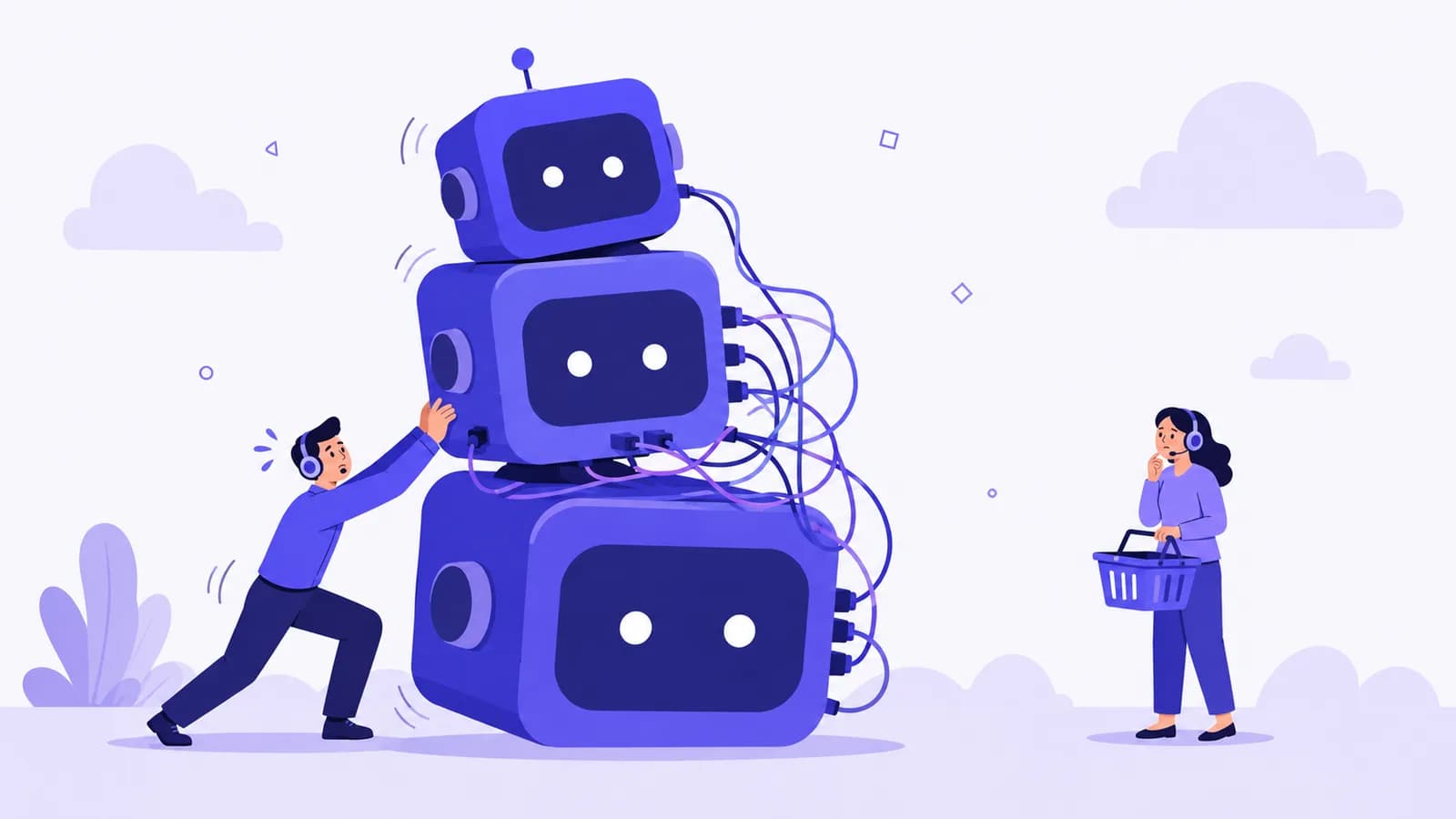
Intercom Now Needs 3 AI Products to Do What DeskLeap Does in One
·8 min read
Update - 23 September 2026: The deal has closed. Salesforce completed its acquisition of Fin (formerly Intercom) on 10 September 2026 (Salesforce press release, “Salesforce Completes Acquisition of Fin”). Our June note on this article forecast a close in early 2027; it closed sooner. The announcement says nothing about changes to Fin’s pricing or packaging, so treat any figure below as the last published price and check your own renewal terms. That changes the calculus in this article - see our full analysis: what the Salesforce acquisition means for your support team.
Note, 20 September 2026: this headline counts three products, and Intercom’s own framing no longer does. intercom.com now presents the lineup under the heading “Two products, one seamless experience” — Intercom (the helpdesk) and Fin (the AI agent). Operator is still a real, separate product, but it lives on fin.ai rather than in intercom.com’s product framing, and “Intercom 2” appears on intercom.com only as a navigation label under “HELPDESK FEATURES”. We have left the count and the analysis below unchanged: which number you get depends on which of their two sites you read, which is rather the point of the article.
Intercom — or rather, Fin, as the parent company now calls itself — just launched its third AI product: Operator. It joins Fin (the customer-facing AI agent) and Intercom 2 (the rebuilt helpdesk platform) to form a three-layer product stack.
Operator is an "AI operations agent" with 50+ tools and 10 skills. Its job? Managing your knowledge base, debugging Fin when it underperforms, building automation rules, handling incident response, and pulling team analytics.
In other words, Intercom built an AI to manage its other AI. If that sounds like a complexity problem masquerading as a product launch, that's because it is.
The Three-Layer Stack, Explained
Here's what Intercom's product lineup now looks like:
Layer 1: Fin — Customer-Facing AI ($0.99/resolution)
Fin handles customer conversations. It reads your help center, resolves common questions, and escalates to humans when it can't. Pricing: $0.99 per AI resolution, with a reported 66% average resolution rate. Fin can now run on Zendesk and Salesforce too — not just Intercom.
Pricing correction, 20 September 2026: Fin’s published unit is no longer called a “resolution”. Under the heading “Fin with your current helpdesk”, fin.ai/pricing now reads “$0.99 PER OUTCOME” with “50 OUTCOMES PER MONTH MINIMUM”, and the page carries an FAQ headed “What counts as a Fin outcome?”. The price per unit is unchanged, so the totals below still hold at this volume, but two things in this article were incomplete: the unit is an outcome rather than a resolution, and there is a minimum spend of 50 outcomes a month — about $49.50 — whether or not you use them. That floor does not affect a team handling 8,000 conversations, but it does affect the smaller teams this article is written for.
Layer 2: Operator — Operations AI (Pricing TBD)
Operator manages the operational side of support. Its capabilities include:
- Knowledge base management: Detects when product changes affect articles, drafts edits in your brand's tone, identifies content gaps, proposes new articles
- Fin debugging: Identifies conversations where Fin underperformed, finds root causes, proposes fixes to improve resolution rates
- Automation building: Constructs Procedures (Intercom's automation framework), configures Guidance rules, analyzes automation opportunities
- Incident response: During outages, identifies affected conversations, drafts targeted responses, sends proactive messages to impacted customers
- Team analytics: Pulls agent performance metrics, surfaces outliers for coaching opportunities
Intercom describes it as "like having five additional knowledge managers on the team." Pricing hasn't been announced — expect it to be a per-seat or per-usage add-on.
Layer 3: Intercom 2 — Rebuilt Helpdesk Platform ($39+/seat/month)
The traditional helpdesk: inbox, ticketing, customer data, reporting. Intercom 2 is a ground-up rebuild of their original platform, designed to work with Fin and Operator. Seat-based pricing starts at $39/month.
The Total Cost of the Three-Layer Stack
Let's estimate the monthly cost for a 10-agent team handling 8,000 conversations:
| Product | Pricing Model | Estimated Monthly Cost |
|---|---|---|
| Intercom 2 (helpdesk) | $39/seat × 10 agents | $390 |
| Fin (customer AI) | $0.99 × 5,280 resolutions (66%) | $5,227 |
| Operator (ops AI) | TBD (likely per-seat or usage) | $??? |
| Total | $5,617+ /month |
That's at minimum $67,400/year before Operator pricing is even factored in. And it requires learning three products, managing three billing lines, and understanding how three AI systems interact with each other.
Compare to DeskLeap:
| Product | Pricing Model | Monthly Cost |
|---|---|---|
| DeskLeap (platform) | Free — every agent | $0 |
| Total | AI Agent $29/month each if you add it | $0, or $290/month with the AI Agent on all 10 |
Annual cost: $0, or $3,480 with the AI Agent on all 10 agents. One product. One invoice. One dashboard.
Why You Shouldn't Need AI to Manage Your AI
Operator's existence reveals something important about Intercom's architecture: Fin is too complex to manage without another AI product.
Think about what Operator actually does:
- Knowledge base management — This should be a feature of your helpdesk, not a separate product. If your platform can't keep articles in sync with product changes, the knowledge base architecture is the problem.
- AI debugging — If your AI agent needs a second AI to figure out why it's failing, the first AI's transparency and reporting are insufficient.
- Automation building — If you need AI to build your automation rules, the automation system is too complex for humans to manage. That's a design problem, not a feature.
- Incident response — Proactive incident messaging should be a native capability of your helpdesk, triggered by status page integrations or manual alerts — not a separate AI product.
- Team analytics — Agent performance metrics are a core reporting feature. Every helpdesk has them. They don't require a dedicated AI product.
Each of Operator's capabilities is something that should be built into a well-designed helpdesk. The fact that Intercom needs a separate product for these functions suggests their core platform lacks the native intelligence to handle them.
The Complexity Tax
Every product layer adds overhead:
Learning curve × 3
Your team needs to understand how Fin works (conversation handling, escalation rules), how Operator works (when to let it auto-manage vs override), and how Intercom 2 works (inbox, ticketing, reporting). Three products means three sets of documentation, three configuration interfaces, and three mental models for how things work.
Debugging complexity × 3
When a customer gets a bad response, was it Fin's fault (wrong knowledge retrieval), Operator's fault (bad article edit), or Intercom 2's fault (routing issue)? Debugging across three AI systems is exponentially harder than debugging one integrated platform.
Billing unpredictability × 3
Seat-based pricing for Intercom 2. Per-resolution pricing for Fin. Unknown pricing for Operator. Three billing models means three variables in your monthly cost forecast. Finance teams already struggle with per-resolution pricing alone — adding a third billing dimension makes budgeting even harder.
Vendor lock-in × 3
The three products are designed to work together. Once Operator is managing your Fin configuration and your Intercom 2 automations, extracting yourself from the ecosystem becomes significantly harder. This is the real strategy behind the three-layer stack: make each product dependent on the others until switching costs become prohibitive.
What "Built-In" Looks Like
Every capability Operator offers exists natively in DeskLeap — not as a separate product, but as part of the platform:
| Operator Feature | DeskLeap Equivalent |
|---|---|
| KB article management | Built-in knowledge base with AI-powered search |
| AI debugging & optimization | AI confidence scoring + resolution analytics in one dashboard |
| Automation building | AI-powered routing — no manual automation rules needed |
| Incident response | Bulk actions + proactive messaging built into ticketing |
| Team analytics | Agent performance metrics in the reporting dashboard |
The difference isn't just feature parity — it's architectural simplicity. These capabilities work together because they're part of the same system, reading the same data, using the same AI. There's no handoff between products, no integration layer, no separate billing.
The Bigger Question
Intercom's three-product strategy raises a fundamental question for the helpdesk industry: is the future of customer support more AI products, or smarter platforms?
Intercom is betting on more products — specialized AI agents for each operational function, each with its own pricing and complexity. The pitch is compelling: "Look at all the AI we have."
The alternative approach — which DeskLeap and other AI-native platforms represent — is to build intelligence into the platform itself. Not as a bolt-on, not as a separate product, but as a native capability that works because it's part of the same system.
The more AI products you need to manage your AI, the more you should question whether the underlying architecture is right.
The Bottom Line
Intercom now requires three products — Fin, Operator, and Intercom 2 — to deliver AI-powered customer support. Each adds cost, complexity, and cognitive load. For a 10-agent team, the stack costs $67,400+/year before Operator pricing is even announced.
DeskLeap delivers the same capabilities in one platform — free, or $3,480/year with the AI Agent on all 10 agents. One product to learn, one price to pay, one vendor to manage.
The question isn't whether AI can transform customer support. It's whether you want three products to do it, or one.